What is lactation nutrition? Why is it important?
Lactation nutrition (aka nutrition while breastfeeding) … I hope to explain generally foods and habits you can do while you feed your newborn for his/her optimal health & development. Full disclosure: I am only a registered dietitian, so in terms of the nuances of breastfeeding, I can only recommend what the mother should eat as well as how much the baby needs!
https://www.llli.org/breastfeeding-info/ is a great source for all your A-Z questions and provides the information in 101 languages. It even has articles on if you’ve lost your baby and are expressing milk, what to do if you have postpartum anxiety or depression, or complications with latching/feeding your newborn. There is also information on weaning, when you decide it is the right time for yourself and your newborn.
How often and how much to breastfeed:
– The CDC Recommendations
Lactation consultants can help you troubleshoot feeding your newborn.
THE Q & A
What’s so special about breastmilk?
Colostrum is the early breast milk that is beneficial for your baby for many reasons: provides protection from inflammation and harmful microorganisms and clears the baby’s system of meconium (black stool) which is important in preventing jaundice. Colostrum is important for preterm babies and lasts about a few weeks into the breastfeeding milk production.
Breast milk contains everything your baby needs for the first 6 months of life, and over time the composition changes to accommodate your baby’s needs. As the milk production progresses, it becomes less watery, higher in fat and more nutritious. The oligosaccharides in the milk (big word for carbohydrates) serve as prebiotics that are digested by the infant’s gut bacteria. The concentrations of these carbs are variable between women and change over the course of lactation.
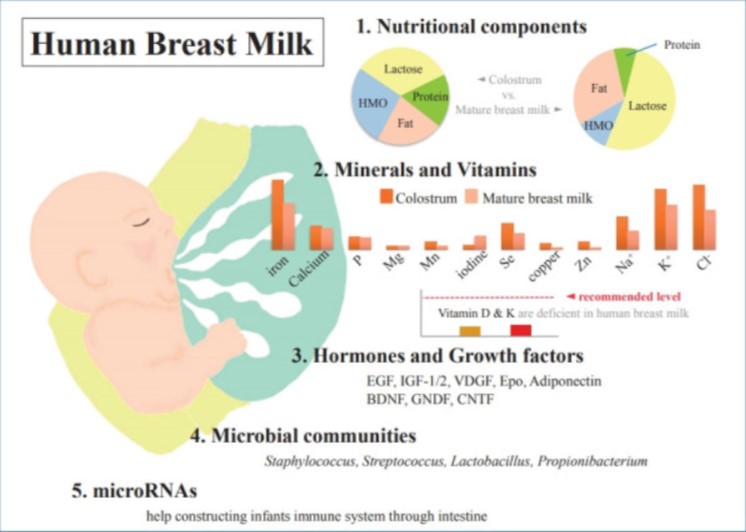
doi: 10.3345/cep.2020.00059. Epub 2020 Mar 23.
From <https://pubmed.ncbi.nlm.nih.gov/32252145/>
Your diet actually does have a role on what the breast milk is made of (makes sense since your body makes it out of what you’ve already consumed!). The best thing you can do is eat a diet that is nutrient dense. Meaning high quality protein, fruits, vegetables, nuts, seeds, and fiber-rich starches.
- Fish and seafood: Salmon, seaweed, sardines, *see list below on seafood from FDA
- Meat and poultry: chicken, lean beef, lamb, pork, eggs, and turkey
- Fruits and vegetables: Eat the rainbow! The more color means there is a greater variety in nutrients.
- Nuts and seeds: walnuts, almonds, chia seeds, hemp seeds, flaxseeds
- Healthy fats: avocados, olive oil, full-fat yogurt [ideal ratio of omega 3 and omega 6 index – it’s important to get adequate amounts of both for your body to be metabolically balanced!]
- Other foods: plant proteins like tofu, tempeh, and edamame, also dark chocolate, kimchi and sauerkraut
Are there any special diet recommendations?
Yes. As a breastfeeding mother you will need additional calories to support the production of milk. It takes up to an additional 500 calories consumed per day in order to support that production. The average is around 350 kcal. Additionally, iodine and choline are recommended to be consumed in greater quantities throughout the first year postpartum. 290 mcg iodine and 550 mg choline are needed daily. (2)
Eggs, meats and seafood are good sources of both, while iodized salt is a good source of iodine and beans/lentils are a good source of choline.
Are there any foods that should be avoided during breastfeeding?
Some – in certain cases. Seafood options all have varying amounts of mercury, and those fish higher on the food chain contain more. Refer to this chart for the good choices: Advice About Eating Fish (October 2021) (fda.gov). Eating fish has so many health benefits, and it’s great to consume 2-3 times per week in 4 ounce amounts. Another food to consume with caution is caffeine. Max consumption should be no more than 300 mg. Preterm and younger infants break down caffeine slower, and if an infant appears to be more fussy or irritable after high caffeine consumption, the mother should consider decreasing her consumption.
Common sources of caffeine are coffee, sodas, green tea, black tea, energy drinks, and chocolate
1 cup coffee = ~120 mg caffeine
What if you’re a vegan or vegetarian that is breastfeeding?
The major micronutrients at risk are B12, choline, iodine, zinc, or omega 3s (DHA/EPA). If you adhere to this type of diet regularly, it might be a good idea to consider supplementation. Consult with you dietitian and health care provider! (2,3)
OTHER RANDOM QUESTIONS:
Can I drink alcohol and breastfeed?
Moderately. One standard drink is not known to be harmful to the infant, especially if the mother waits at least 2 hours after that drink before nursing.
1 standard drink = 5 oz wine, 12 oz regular beer, 1.5 oz liquor, which are all roughly 14 grams of pure alcohol. (4)
However, it is important to know that exposure to alcohol above moderate levels can be harmful to the development, growth and sleep patterns of your infant.
Alcohol can also be found in highest amounts in breastmilk 30-60 minutes after the beverage is consumed and is detected for about 2-3 hours after the drink is consumed. The more alcohol consumed, the longer it will be present in the milk. Length of time present varies, and can depend on amount of alcohol consumed, how fast it was consumed, whether food was eaten, mother’s weight, and how fast alcohol is broken down in the mother’s body.
Can expressing/pumping breast milk after consuming alcohol reduce the alcohol in the mother’s milk?
No. The alcohol level in the breast milk reflects the level of alcohol in the mother’s bloodstream. As the alcohol is metabolized in the mother, the levels will drop in the breast milk. It’s up to you whether you want to wait two hours, express the milk and dump it, or choose to feed the infant milk that has been previously expressed.
Can I lose weight while breastfeeding?
Possibly, but shouldn’t be the priority. While you do expend an additional 500 or so calories breastfeeding, it’s important to not cut calories too much, or you could risk a lull in milk production (or decreased quantities altogether). It’s natural to want to shed your baby weight, and breastfeeding has been shown to help. (6,7) While some studies do have correlations showing longer breastfeeding times lead to more weight loss, or even a quicker return to pre-pregnancy weight, it’s important to remember that this is not a direct cause and effect. More studies are needed to determine exact numbers! Work with your physician and dietitian if you want to safely lose weight, protect your milk supply and baby.
SOURCES >>
| (1) | Clin Exp Pediatr. 2020 Aug;63(8):301-309. doi: 10.3345/cep.2020.00059. Epub 2020 Mar 23. From <https://pubmed.ncbi.nlm.nih.gov/32252145/> |
| (2) | Maternal Diet | Breastfeeding | CDC |
| (3) | Karolina Karcz & Barbara Królak-Olejnik (2021) Vegan or vegetarian diet and breast milk composition – a systematic review, Critical Reviews in Food Science and Nutrition, 61:7, 1081-1098, DOI: 10.1080/10408398.2020.1753650 From <https://www.tandfonline.com/action/showCitFormats?doi=10.1080%2F10408398.2020.1753650> |
| (4) | Alcohol | Breastfeeding | CDC |
| (5) | What Is A Standard Drink? | National Institute on Alcohol Abuse and Alcoholism (NIAAA) (nih.gov) |
| (6) | Diet and weight loss while breastfeeding | Australian Breastfeeding Association |
| (7) | Effects of breastfeeding on postpartum weight loss among U.S. women (nih.gov) |
| (8) | Nutrition During Lactation | Food and Nutrition Information Center | NAL | USDA |
 Aspire Higher
Leave a comment